

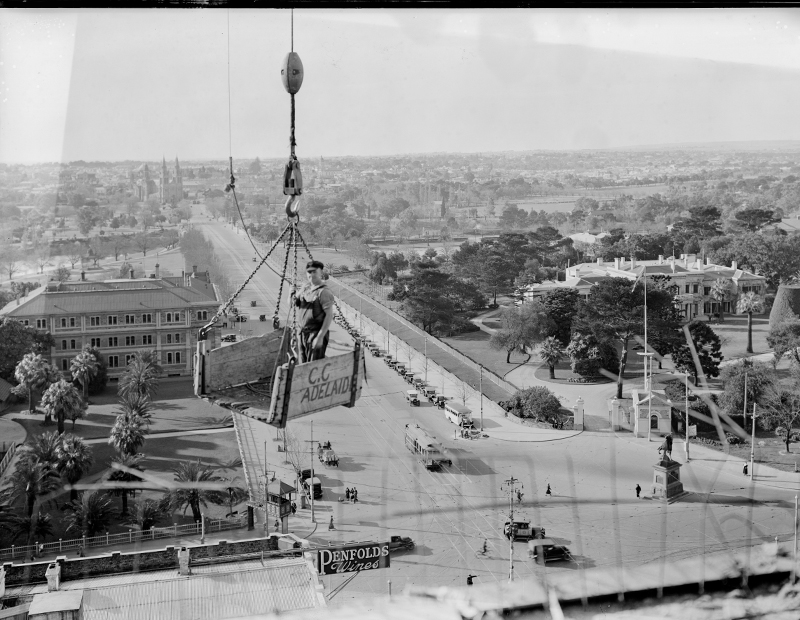
SRSA GRG35/342/1/311/box697/GN05612
Photos captured by photographer Frank Hurley of Adelaide, South Australia and the Northern Territory in the 1930s have been preserved by State Records of South Australia.
The images, almost all of which were captured on glass plate negatives, were taken to promote South Australia’s 1936 Centenary celebrations.
Among the shots are North Terrace featuring the Jubilee Exhibition Building, a man in a crane above King William Street overlooking Government House, Victoria Square, the Adelaide Botanic Garden Palm House, people picking oranges near Renmark, lakes around Mount Gambier, and the old Causeway at Victor Harbor, to name a few.
The photos, which have been digitised, can be seen as part of a Flickr album here (external site) (external site) (external site).
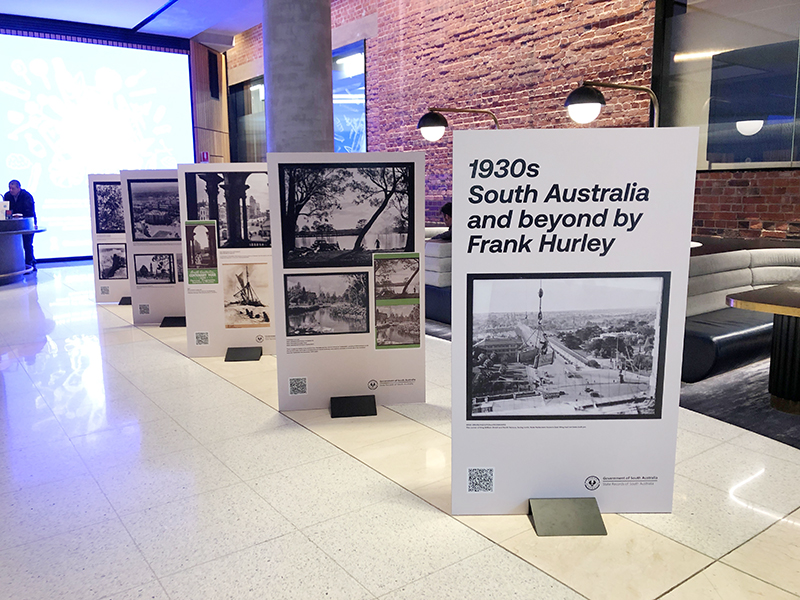
The foyer at GPO Exchange, Adelaide. Picture by SRSA
1930s South Australia and beyond by Frank Hurley
A selection of these images appear in an exhibition at the GPO Exhchange at 10 Franklin Street Adelaide.
Many of these images have been paired with marketing materials they were published in as part of the Centenary celebrations.
The exhibition 1930s South Australia and beyond by Frank Hurley is open Monday to Friday, 9am-5pm, until Friday, October 16, 2026.

Hurley (October 15, 1885, Glebe, Sydney – January 16, 1962, Collaroy Plateau, Sydney) was an Australian photographer, film-maker, and adventurer.
He was chosen as the official photographer for expeditions to Antarctica with Sir Douglas Mawson (Australasian Antarctic Expedition 1911-1914) and Ernest Shackleton (British Imperial Trans-Antarctic expedition, 1914-1917).
He went to Antarctica six times, with his last being a trip with Mawson in 1929 as part of the British, Australian, New Zealand, Antarctic Research Expedition (BANZARE) [1], [2].
Hurley was also an official photographer for the Australian Imperial Force during World Wars I and II[3].
Hurley was commissioned by the government to create a series of promotional materials for South Australia’s Centenary in 1936.
The project was meant to be a historic film built around colonist Mr Simpson Newland’s book Paving The Way. But it turned into a series of photographs that could be used for publicity, plus two films, Here is Paradise: A Tour of the Garden State of South Australia (watch below) and Oasis.
This was spurred in part by a letter to the Centenary Committee Chairman Sir David Gordon from The Advertiser’s Lloyd Thomas. Not only did Thomas say it would be better to make a series of photos and videos promoting the state as it is today, but that Hurley, as “the best scenic photographer in Australia” should be commissioned for the project [4].
The resulting films, Here is Paradise: A Tour of the Garden State (external site) (external site) (external site) and Oasis were distributed at locations including Britain and Commonwealth countries [5] plus there were proposals for it to be shown in France and Germany by Greater Union Theatres [6].
Hurley took dozens of photographs across the state and into the Northern Territory in 1935 for the project, with highlights across Adelaide, the Riverland, Fleurieu Peninsula, and Central Australia.
Among his great shots of the city is a man in a crane suspended above King William Street and North Terrace before Parliament House’s East Wing and the Adelaide Festival Centre were built and North Terrace before Bonython Hall was finished and where the Jubilee Exhibition Building once stood. Other photos include the Colonial building – once South Australia’s tallest building – and sheep roaming near Saint Paul’s Cathedral.
The dramatic cliff faces of the Murray River banks at Renmark, camels at Farina, lakes of Mount Gambier and centuries-old granite boulders near Victor Harbor are just some of the highlights he snapped in the state’s regional areas.
More subtle, recurring features across the images are his assistant Bert Nicholas, two “usherettes”, and a Vauxhall car used to transport the team for the project.
The project’s legacy
The State Centenary Celebration was an early form of South Australia marketing itself as a desirable tourism destination for interstate travellers.
Marketing materials from the campaign promote camping and cruising along the Murray River, exploring the Adelaide Botanic Garden, the fresh produce grown within the state, and the city’s growth and expansion with rising towers.
State Records’ Digitisation Officer Sophie Mossimann said Hurley’s images were distinctive in how he used shadows and lines to create dramatic, captivating images.
The shadowed columns of the Adelaide Town Hall balcony opening up to the light of King William Street and the dark Murray River’s cliff faces against the open waters at Renmark are two examples of this.
“He could create extra drama and depth to images just by playing with the light, especially by having the sun pointing near the front of the camera lens,” she said.
“Many of his images have also been copied in their style; the people picking fruit at Renmark is an iconic shot that has been replicated many times.”
Hurley captured most of the images on glass plate negatives, a photographic technique where a light-sensitive emulsion layer is supported within a sheet of glass.
The plate fit inside the camera, and photographers would take a photo by exposing the plate to light. The plate's emulsion reacted with light and air, producing a high-quality image.
Only one image could be taken with each plate. This type of photograph was produced between the 1890s and the 1950s.
These glass plates were cleaned, digitised and re-housed in acid free containers in 2021 by Senior Conservator Gillian Leahy.
Unfortunately, due to their fragility, it is not possible to exhibit examples of the negatives.
To see more photos of Frank Hurley’s images, visit our Flickr album here (external site) (external site) (external site).
With thanks to SA Museum, National Library of Australia, State Library of Queensland, History Council of South Australia, Adelaide University and State Records’ archive team for their support, collaboration and resources.
- Antarctica, Frank Hurley, State Library of New South Wales and Graham & Charlene Bradley Foundation, www.sl.nsw.gov.au/stories/antarctica-frank-hurley (external site) (external site) (external site), accessed July 29, 2026
- Information supplied by SA Museum, July 23, 2026
- James Francis (Frank) Hurley, Australian Dictionary of Biography, Australian National University, adb.anu.edu.au/biography/hurley-james-francis-frank-6774, accessed July 29, 2026. Article first published in Australian Dictionary of Biography, Volume 9, (Melbourne University Press), 1983
- GRG7/24 file 228/1939
- Frank Hurley: A Photographer’s Life, pp 349, Alasdair McGregor, Penguin, 2004
- GRG7/29 file 59/1934
Read more
- See Frank Hurley’s photos of South Australia and the Northern Territory in 1935 (external site) (external site) (external site)
- Watch Here is Paradise: A Tour of the Garden State of South Australia (external site) (external site) (external site)
- Find photographs within State Records’ collection
- Priceless: World War II veteran’s teenage years
- David Unaipon: The man on the $50 note
