

Barmaid Registrations
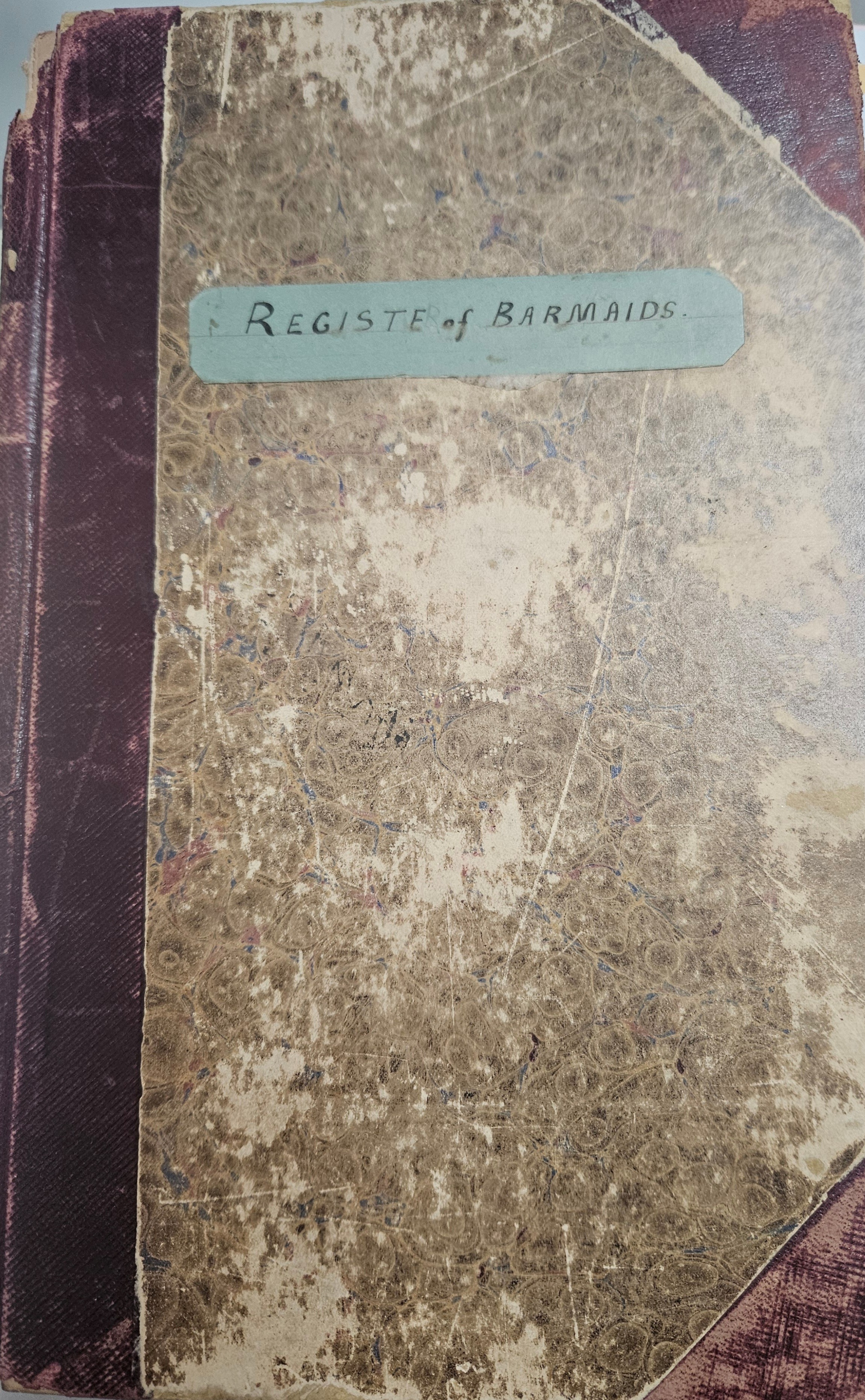
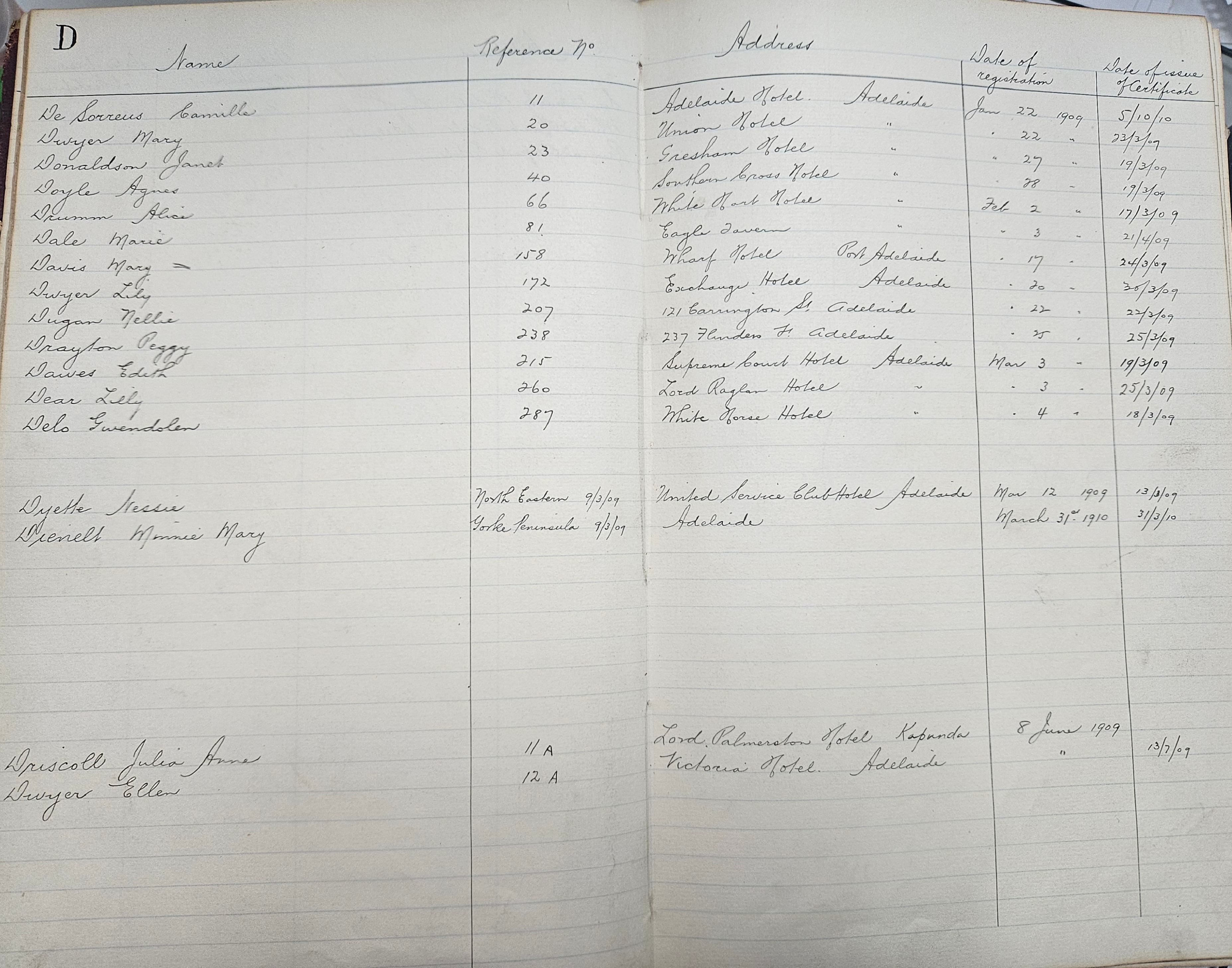
Barmaids were registered in South Australia for about four months in 1909. Having original applications from such a limited timeframe is a small glimpse into the rules and regulations set by the South Australian government at the time. The applications aren’t very detailed and, on their own, give very little information about the lives of the women applicants. However, having records of workers, especially women workers, involved in any private industry is very rare for a government archive.
 |  |
|---|
Licensing Act 1908
Barmaids are not employed because they are cheaper than men, or because they do more work than the other sex would perform…The real reason for their presence in the bar is because a certain class of patrons of the hotels like to have their drink served by good looking, bright, and intelligent women. That is the very aspect of the case which commends the suggestion as to the banishment of barmaids to the temperance organizations, and it is more than likely in the next Parliament…a Bill will be introduced into the State Parliament on the subject. (‘The Barmaid’, “Southern Argus”, 7 June 1906, p. 4, https://trove.nla.gov.au/newspaper/article/96964464)
On 31 March 1909, barmaids were outlawed in South Australia. Well, sort of…
Under the Licensing Act 1908, passed on 23 December 1908, no new barmaids could be hired after 31 March 1909. Women who had worked as barmaids for at least three months before the Act weren’t going to lose their jobs, but they had to be registered if they continued serving liquor in a bar.
Female licensees and their daughters or stepdaughters, and the wives, daughters or stepdaughters of male licensees were exempt and could continue to serve liquor without being registered (section 149 (1), section 149 (3) and section 153 (2)).
Definition of a Barmaid
‘Barmaids’ were women who sold, supplied or served liquor specifically in a ‘bar-room’. The Act notes a bar-room was ‘any bar, bar-room, bar-parlor, shop, or other room or place used exclusively or mainly for the sale, supply, serving, or consumption of liquor’ (section 149 (4)). Barmaids were not permitted to work after 11pm (section 154 (1)). There was nothing in the Act prohibiting the employment of women in other areas of licensed premises, for example as housemaids or waitresses who did not serve alcohol.
The Act did not place any age restrictions on barmaids, although nobody under the age of sixteen was allowed to be in a bar-room, unless they were the child of the licensee (section 144).
Petition Against Barmaid Employment
The clauses around barmaids and their registration (and eventual abolition) were introduced by Thomas Hyland Smeaton, Member for Torrens. In November 1908, he presented the House of Assembly with a petition signed by 12,000 people against the employment of barmaids, which stated “it was wrong to allow the charms and grace of young women to be used in order to lure men to drinking and ruin.” (‘Petition Against Barmaid Employment’, “Border Watch”, 14 November 1908, p. 3: https://trove.nla.gov.au/newspaper/article/77449702).
Abolition of Barmaids
The idea behind these sections of the Act were for barmaids to slowly disappear from South Australian bars. In 1905, long before the Act was passed or even discussed in Parliament, Mr. Tom Price (soon-to-be-Premier) favoured “the “abolition of barmaids,” but would give them a time limit, as he would not like to see them forced out of their positions all at once. “The present barmaids should be registered, but none should be admitted after a certain date, and it was to be hoped that a lot of those listed would soon drop out by getting married.” (‘The Liquor Trade’, The Advertiser, 9 May 1905, p. 4: https://trove.nla.gov.au/newspaper/article/5046131).
Ten Year Rule
In 1906, Lady Holder, President of the Women’s Christian Temperance Union (W.C.T.U.), stated:
We have a clause introduced by Mr. Smeaton to be added to the Licensing Act, stating that no more women may be allowed to be employed after the passing of the Act, that those employed already shall all be licensed and that a limit of 10 years shall be asked for before the system is completely forbidden. We agree with all but the last clause, and we feel that none or very few women can remain 10 years in such surroundings without serious deterioration in all that is womanly and best. As women we protest that our sex should be used for such purposes as to attract our young men by their beauty and brightness to such unworthy ends…For the sakes of the mothers, wives, and sisters we love and respect let us help to get this blot on our land removed, and speedily. (‘The Barmaid Problem’, Evening Journal, 18 September 1906, p. 1: https://trove.nla.gov.au/newspaper/article/201884130).
Despite that barmaids would marry and then leave their work, there was nothing legally prohibiting married women from working in bars (in fact, single women were not allowed to be licensees after 1909).
The ’10 year rule’ was also never implemented and the last registered barmaid was still pulling pints at the Oriental Hotel, Rundle Street in 1950 (‘May be move for barmaids’, “News”, 2 November 1950, p. 29: https://trove.nla.gov.au/newspaper/article/130288261).
Applications for Registration
At State Records, we have the original applications for registration from 1909 in GRG67/50 and the registers of barmaids in GRG67/25. Not all the original applications are held, noticed when comparing the registers with the applications, and most of the applications are from the Adelaide metropolitan area or the Barossa Valley.
Lily Dear
The last working registered barmaid in Adelaide was Lily Dear, whose application is held in GRG67/50.
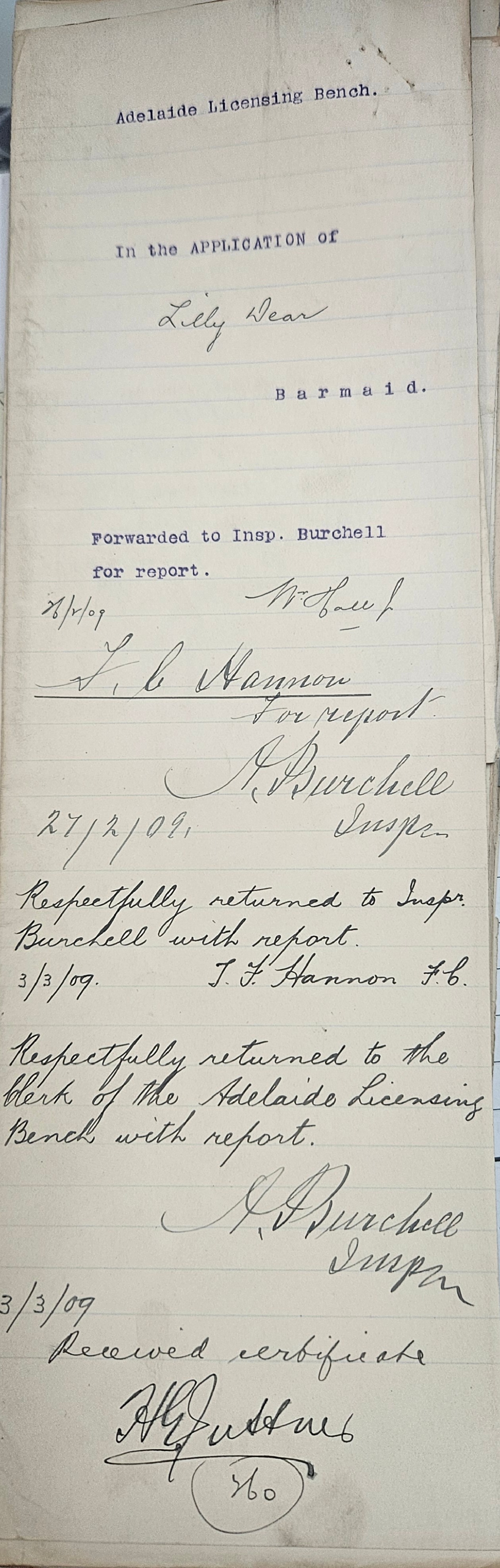
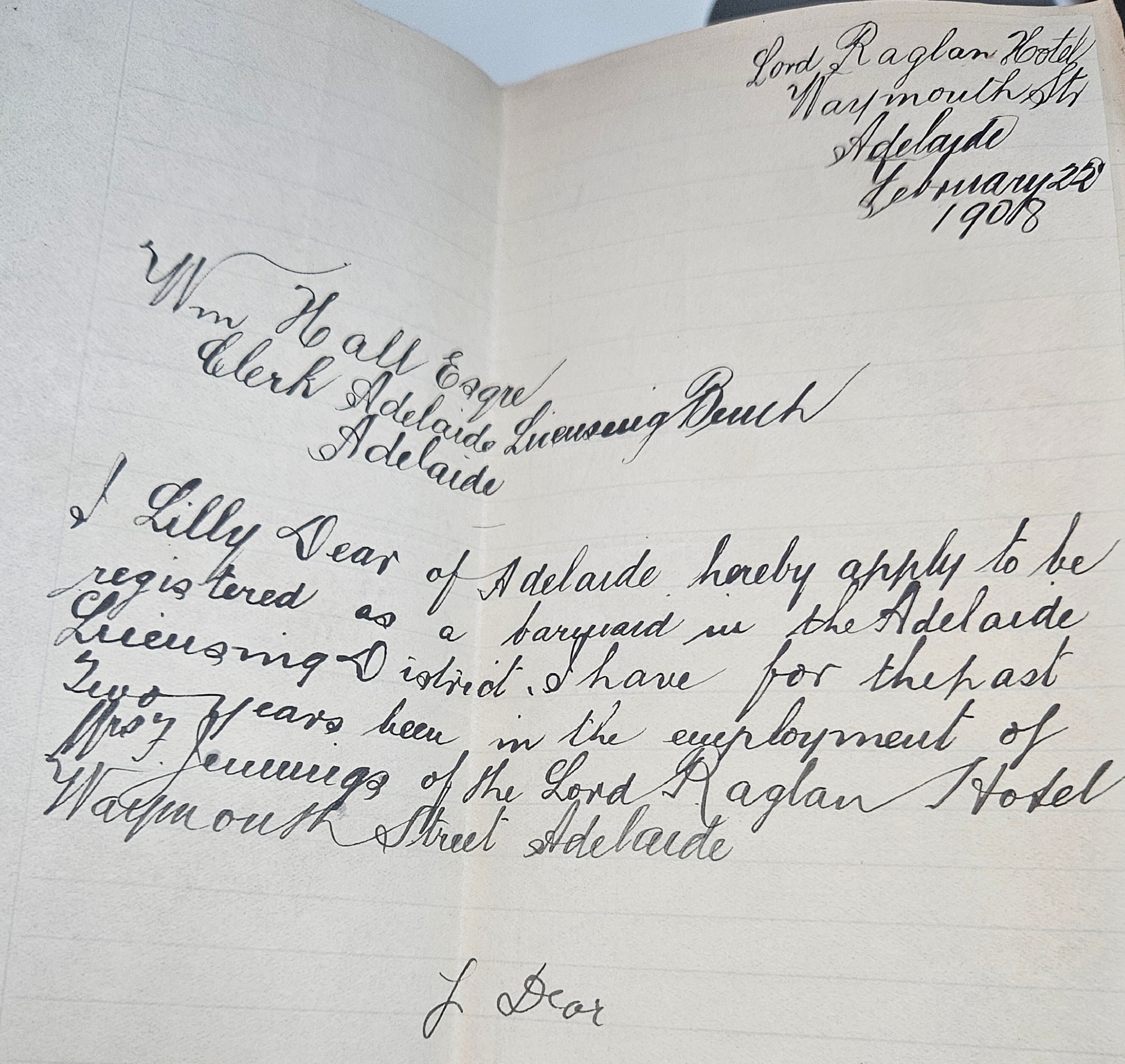
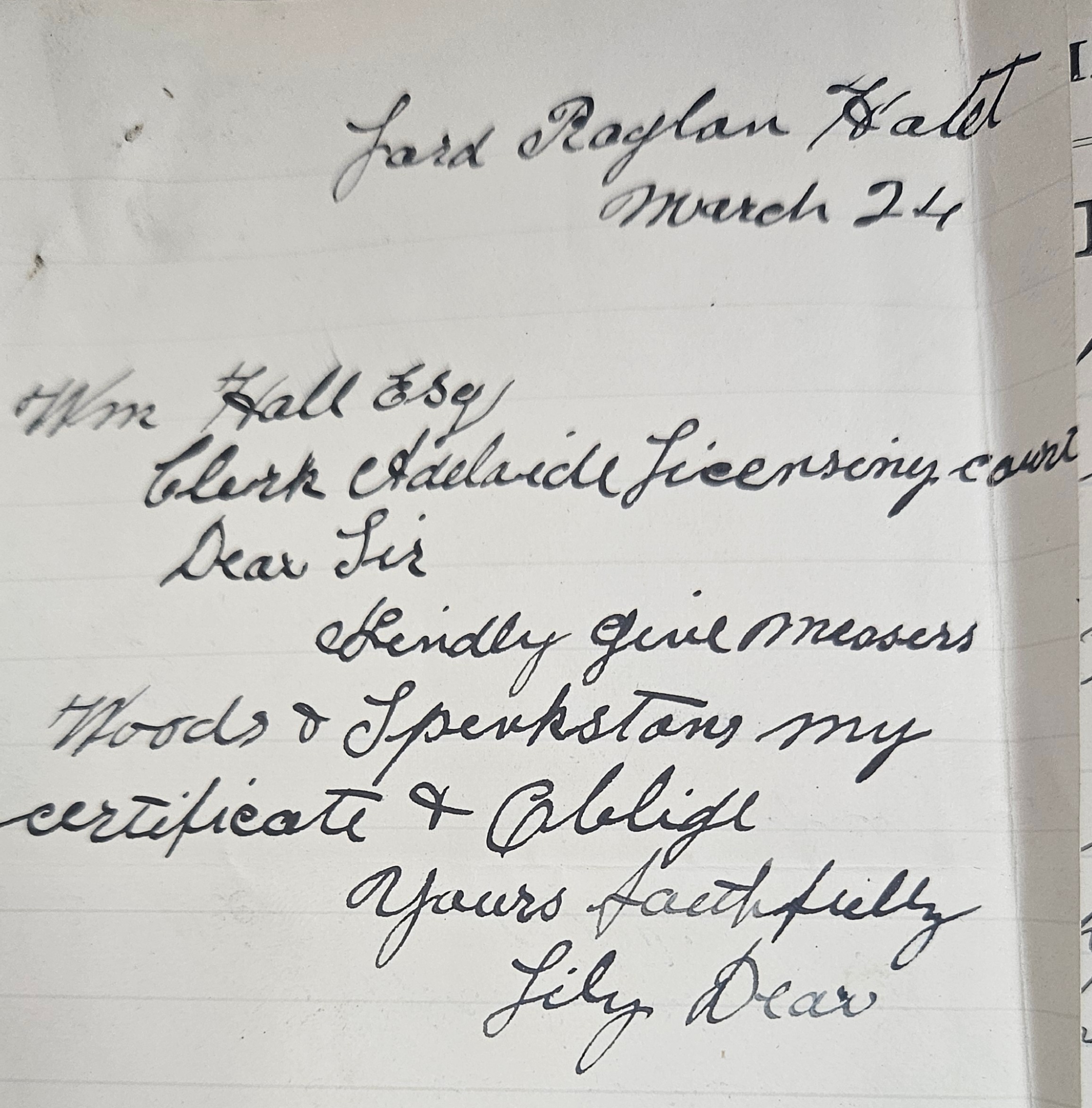
Lily Dear was amongst the first batch of barmaids to receive their registration certificates in March 1909. She was a barmaid at the Lord Raglan Hotel on Waymouth Street (now the Cosmos Club) and she and her fellow barmaid, Lillian Pedler, applied to the Licensing Branch on 22 February 1909.
|
|
|---|
Lily's Police Report
The police report into Lily’s application just states that she worked as a barmaid at the Lord Raglan for all of 1908. It does not give any information as to when she started, nor anything like an ID check or even a character reference like you might think would come up today.
|  |
|---|

City's Lone Barmaid
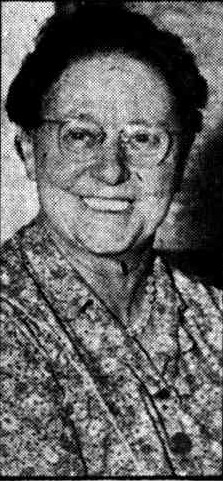
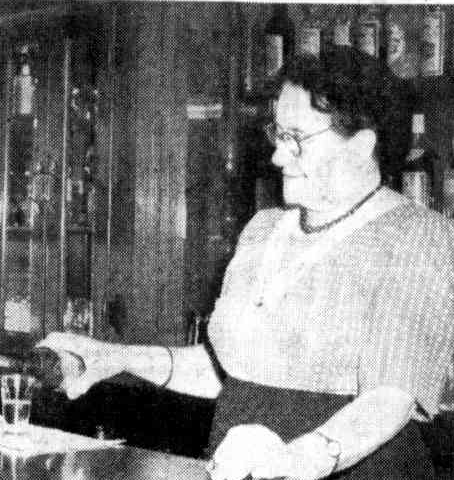
In 1949, forty years after the Act, Lily was featured in the Mail as the “City’s Lone Barmaid” (’40 Years on Job’, “Mail”, 2 April 1949, p. 12, https://trove.nla.gov.au/newspaper/article/55926911).
A year later, she appeared in the News, stating “women behind the bar improve the tone of a hotel because they ‘command respect from the drinkers and are cleaner in their work than men.’” Lily pointed out that there was one other registered barmaid still in Adelaide but she was not working at the time, as she was caring for her sick son, leaving Lily as the only working barmaid in Adelaide (‘Barmaids “would lift tone of hotel trade”’, News, 13 January 1950, p. 3, https://trove.nla.gov.au/newspaper/article/130797167).
The newspaper politely did not reveal her age, but did say that she had celebrated a birthday on 27 December.
27 December 1949 was Lily’s 69th birthday. She was born on 27 December 1880 to Joseph, a labourer, and Emily Ann (nee Hatchard). Her birth was registered at Jamestown on 26 January 1881 by Ann Hatchard (presumably her maternal grandmother). Ann could not sign and, instead, left a mark. Lily’s name was recorded on her birth certificate as ‘Lily Deer’ (SRSA GRS 17733/1, Unit 13).
|
|
|---|
Lily and Ada
Lily moved to Adelaide in 1900 from Whyte Yarcowie, where she lived with her grandparents.
In Adelaide, she first stayed at the Rescue Home, a home run by the Salvation Army in Gilbert Street. At around 10pm on 8 August 1900, she was transferred to the Destitute Asylum’s Lying-in Home on North Terrace (now the Migration Museum on Kintore Avenue). In the early hours of the morning of 9 August, she gave birth to daughter, Ada Alice. She named Alice’s father as a married man whose wife lived in Orroroo. Lily and Ada remained at the Lying-in Home until February 1901, when they left for a ‘situation’ (job in domestic service) at Mitcham. Lily and Ada’s surname in the Destitute Asylum’s records is spelled ‘Deare’ (SRSA GRG28/5, Unit 4, entry 165/00 and SRSA GRG29/15, Unit 1, entry 33/00).
Ada is featured in Behind the Wall, a history of women in the Destitute Asylum by Mary Geyer (2019), and in a permanent exhibition at the Migration Museum (Brett Williamson, ‘Remembering the 1,678 babies born in Adelaide’s Lying-in Hospital, 9 May 2016, https://www.abc.net.au/news/2016-05-09/remembering-the-1678-babies-born-in-adelaides-lying-in-hospital/7395376. Accessed 07/10/2025). Ada was placed in foster care when she was a toddler. When she married at only sixteen, she needed her mother’s permission and was put in contact with Lily. Lily was known as ‘Aunt Lil’ to Ada’s children, but did not publicly acknowledge that she was Ada’s mother (Geyer p. 45).
Oriental Hotel
Lily spent most of her working life at the Oriental Hotel in Rundle Street (‘City’s Lone Barmaid’, The Mail, 2 April 1949, p. 12, https://trove.nla.gov.au/newspaper/article/55926911). The Oriental was known as the ‘Hamburg Hotel’ until World War I, when anti-German sentiment prompted a name change. The building still stands on the south-east corner of Rundle Mall and Gawler Place. It is now known as the ‘Walsh Building’ and houses shops at the ground level (‘Oriental Hotel, Rundle Street, 1964’, Experience Adelaide, https://www.experienceadelaide.com.au/photo-library/lost-pubs-of-adelaide/oriental-hotel-rundle-street-1964-1/. Accessed 07/10/2025).
Lily passed away in 1958, at the age of 77. It wasn’t until 1967 that women were permitted to work as barmaids again, with section 157 (1) of the Licensing Act 1967 stating that women working as barmaids had to be employed under an industrial award, determination or agreement and had to receive the same remuneration “as a male engaged in the same employment.”
